
Wow, the action design and presentation of Phantom Blade Zero are really cool—they gave us a lot of excitement and inspiration. Uh, many of my colleagues and friends are actually die-hard Delta Force fans. Past and present, wuxia and shooting, third-person and first-person—on the surface it sounds like quite a big difference. But hey, it's precisely because the difference is big that it can bring players some unexpected good things. If you can pull off wuxia moves in Delta Force, just thinking about it feels fun. Games are meant to be fun, and I believe everyone will find this crossover really enjoyable. Yin Zhenglin's kung fu, the punk style, and the gorgeous move sets are all very appealing, and wuxia is a shared sentiment for all of us.
Inside Phantom Blade Zero there is the flash of blades and swords, and in Delta Force there are also many highlight moments of breaking through adversity. At the same time, the Lin You Tang team's pursuit of craftsmanship and their polishing of details resonated deeply with us. So we actually got in touch quite early on, hoping to work together and create some unique content for players. Delta Force is, without question, already a phenomenon-level game. Many people around me are deeply invested in it. For a domestic Chinese shooter to achieve such high quality and such results—and since we're all making Chinese games—we found it really inspiring. This crossover between Phantom Blade Zero and Delta Force is really about conveying wuxia culture through another game language.
I think it's a particularly meaningful and also very interesting thing. This crossover includes crossover weapon skins, a weapon skin bundle, crossover events, and more. The most representative item is a melee weapon from Phantom Blade Zero. We've made quite a few melee weapons in the past, and I know players have always cared a lot about weapon feel, whether the animations are cool enough, and whether there's anything fresh. We've been working hard on this all along. Bringing Phantom Blade Zero's weapon into Delta Force this time, we want to give players a refreshing, free-spirited wuxia action experience in Delta Force—letting players experience Phantom Blade Zero's weapon and moves from a first-person perspective.
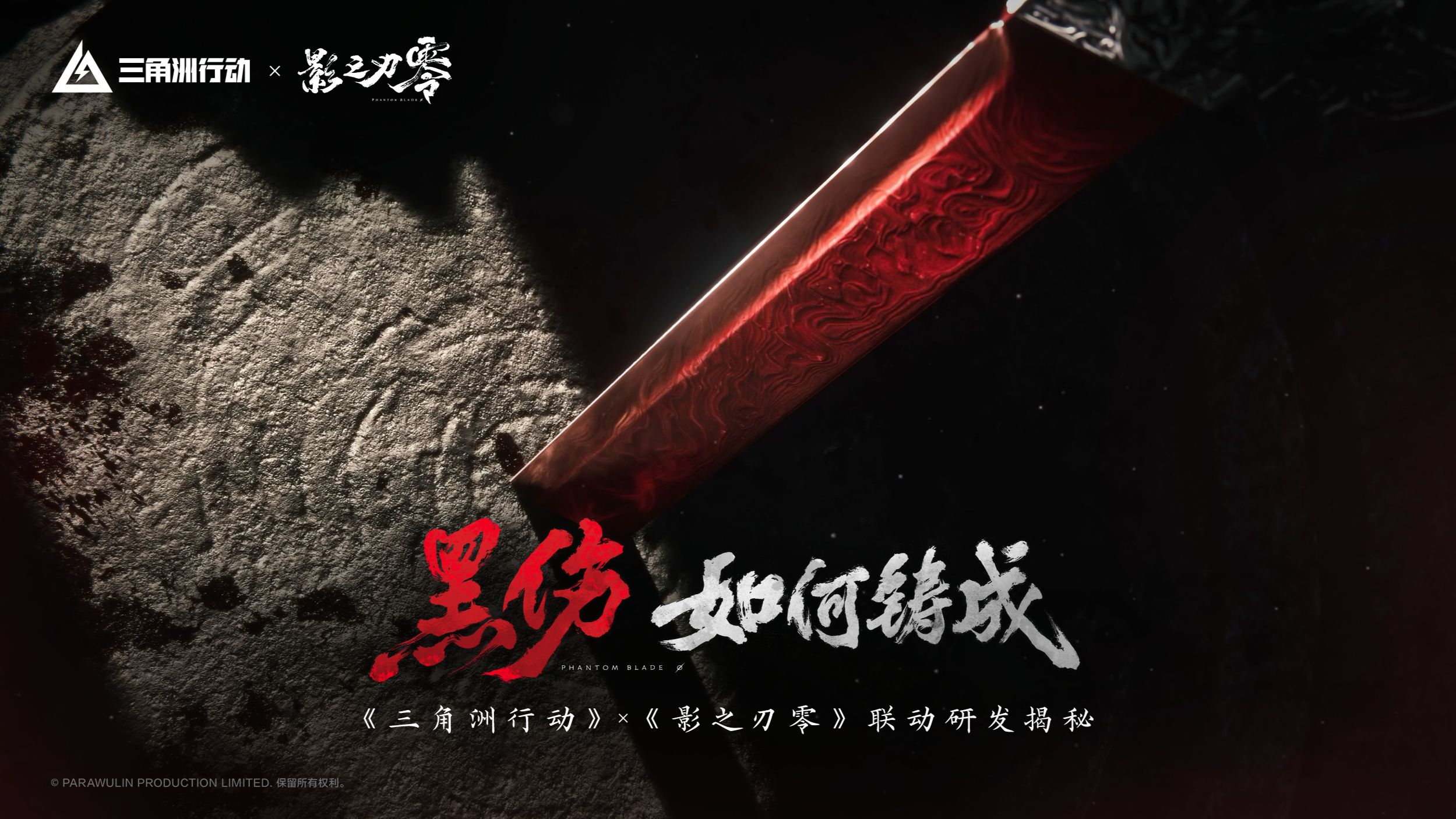
This point actually attracted us from the very beginning, because Phantom Blade Zero itself has a wuxia-punk style. Uh, it's a bit like wielding the weapon yourself in battle—that feeling is wonderful. At the same time, through our brainstorming together, bringing a wuxia-style weapon into a brand-new battlefield is also a very interesting experiment. Actually, from the very start, there was never any suspense for us about which weapon to bring into Delta Force—it had to be Hei Shang (Black Blade), the exclusive weapon of Soul, the protagonist of Phantom Blade Zero. Uh, Hei Shang was actually a weapon I designed 18 years ago when I made my first game, Rainblood, and it was also the codename the protagonist Soul once held within the organization.
Hidden within Hei Shang is the wuxia spirit of Phantom Blade Zero, and it holds unique significance for the Rainblood/Phantom Blade series. Actually, Delta Force also has many characters with deep bonds to melee weapons—for example, Saeed and Chixiao. Hey, I've actually always felt that the operator Wu Ming (Nameless) has a kind of wuxia temperament, and seeing the relationship between Wu Ming and Hei Hai felt quite interesting too. I hope Hei Shang, once in Delta Force, can also bring out many interesting stories. Back to Hei Shang: what impressed me most about this weapon is the dark red blade—or sword—body, and the black-red afterimages when slashing, carrying a strong sense of deadly menace. In Phantom Blade Zero we describe
Hei Shang as "four parts saber, four parts sword," combining the abilities of both blade and sword. Ha, so Soul's moves with Hei Shang also incorporate a design that fuses swordplay and saber techniques. Bringing Hei Shang into Delta Force—how do we preserve Phantom Blade Zero's flavor while letting it blend naturally into Delta Force's battlefield? That's a challenge. Delta Force's previous melee weapons were all products of our own game's background setting, but this time we're bringing Hei Shang, from a Chinese wuxia world, into Delta Force. We hope that when players pick it up, they can feel the artistic and cultural charm of Phantom Blade Zero while not breaking Delta Force's visual consistency. So we first had to reach a consensus with the Phantom Blade Zero team:
which key features of Hei Shang—especially those that highlight Phantom Blade Zero's recognizability—absolutely must be preserved, and which visual details could be fine-tuned and polished according to Delta Force's art style. Once these were clarified, we had a shared standard during production. As the exclusive weapon of Soul, the protagonist of the Phantom Blade series, Hei Shang carries grudges and affections, and is also a symbol of righteousness and honor. Its artistic presentation implies elements of Soul's origins, martial arts characteristics, style of conduct, and personality. When it becomes a weapon in Delta Force, what we need to do is fuse its distinctive features with the modern battlefield, and the hunter's perspective will bring players into closer contact with
Hei Shang, letting them see more details. So we needed to carefully consider the adaptation of its static art presentation and dynamic effects, so that players from both sides can appreciate its charm and harmony. Yes—the weapon's silhouette, shape, patterns, colors, textures, dynamic effects, and even the feel of the overall presentation—we researched and polished all of them meticulously. For example, Hei Shang's most distinctive feature is the dark red color of the blade, its mysterious patterns, and its materials. We first worked to faithfully recreate them based on the settings and references provided by the Phantom Blade Zero team, while also proposing our own adjustment suggestions to achieve the best presentation in Delta Force's environment. After we reached agreement,
we put it into Delta Force's scenes, iterating and polishing through verification under different lighting conditions. We worked closely with the Phantom Blade Zero team in discussion and co-creation, hoping to present the best possible result to our players. The result is great. Honestly, we rarely get to look at it from the enemy's perspective—it feels quite marvelous. Also, the Hei Shang inspection animation designed by the Delta Force team is very clever, incorporating two very important items from Phantom Blade Zero, used in a very skillful way. Hmm, many members of our art team are fans of the Phantom Blade IP—us included. Because of this crossover, we also had the honor of doing an in-depth hands-on experience offline, which was a great inspiration for the design of this crossover.
To strengthen the wuxia immersion brought by the inspection challenge, we incorporated two items from Phantom Blade Zero. One is the bamboo hat (douli), an item the protagonist Soul wears throughout the game. Just imagine—a face half-hidden beneath a bamboo hat, a sword half-drawn from its sheath—doesn't that feeling come instantly? The other is the bell. In Phantom Blade Zero, the protagonist Soul strikes this bell to enter meditation and save the game, which also allows learning skills and teleportation, and his gesture of striking the bell is very distinctive. We hope that when players inspect Hei Shang in Delta Force, they use this gesture to strike the bell, as if completing a spiritual connection between Delta Force and Phantom Blade Zero. When Hei Shang, representing wuxia punk,
Welcome to Delta Force, which is known for its combat-focused design. When using this weapon's moves, we needed to balance the dual characteristics of traditional Chinese martial arts and modern tactical combat systems. And as the perspective shifts from third-person to first-person, players' attention shifts from the character's movements to the movement of the weapon itself.
To perfect the various moves of the Black Shark in Delta Force, we had many exchanges with the Phantom Blade Zero team, and we even visited their motion capture studio to communicate face-to-face with Master Yang. The Black Shark's design prototype is a butterfly knife (balisong), but it is longer and heavier than a typical one, so the rationality of how the weapon is wielded is especially critical. Let's first take a look at this set of moves.
Hmm, in the third-person view, this set of moves works fine—it's very fluid and has that wuxia style. But once you switch to first-person, it falls apart—it's dizzying and chaotic. Indeed, a lot of what can be shown in third person completely disappears in first person. So when we adapt it into Delta Force, we'll need to make some trade-offs. We could try enhancing the variation in the weapon's movement trajectory, including how it coordinates with the hand, while comprehensively reducing the amplitude of body movement—even turning motions—compressing all the ranges of motion.
We want to strengthen the weapon's presentation, so let's try in this direction. OK, I'll go try it. During the process, based on the Phantom Blade Zero team's suggestions, we designed many versions of the plan and kept discussing with them. Revising the collision process was also very meaningful—we really learned a lot. Oh, Master, look, this is our latest version now. How does it feel? Hmm, this is good—this works. We saw it once before during our online communications, and it's indeed quite different from our approach of going from third-person to first-person view. The difference is good. Teacher, look, this is another short blade of ours.
Hmm, a quick-draw slash. As the manga says, this one is also quite good. We can have the motion capture actor try it on the spot and see the effect live. OK, sure, let's do it. Delta Force's first-person production experience was very important for this collaboration and the design of the Black Shark's moves. Based on our long-accumulated experience in wuxia action design and repeated discussions with the Delta Force team, we designed a set of moves that carries wuxia character while also being suited to the modern battlefield. For example, that quick-draw slash is a very wuxia-style move. Yes, we hope every movement detail of the Black Shark can bring everyone the flavor of wuxia. When players pick up the Black Shark in Delta Force, it's as if they become a modern-day knight-errant, facing ever-changing battles in a cyberpunk way.
We have always been committed to conveying wuxia culture to more players through trendy new forms, and this collaboration with Delta Force is a particularly good opportunity. We believe this collaboration will let more people feel the charm of wuxia. Through this collaboration, I can sense that both teams share a similar pursuit of quality and detail. Besides the Black Shark, this collaboration also includes quite a bit of content related to other weapons and storylines from Phantom Blade Zero—for example, a gun skin designed based on the White Python Crimson Chain, as well as an Easter egg related to lion dance. Everyone can go experience it firsthand in the game.
On November 5th, the Phantom Blade Zero and Delta Force collaboration content will fully launch in Delta Force. We hope everyone likes it. We hope you enjoy this collaboration content and give plenty of support to Phantom Blade Zero. We wish Phantom Blade Zero a smooth launch and strong sales—let's open with a fierce assault!